
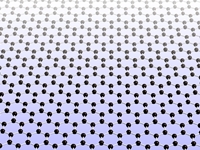
Graphene has a 2-dimensional (2D) honeycomb lattice consisting of carbon atoms. One can obtain graphene by mechanical exfoliation or chemical vapor deposition (CVD). In our laboratory, we mainly produce graphene using mechanical exfoliation.
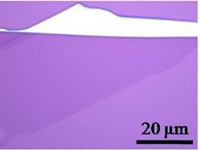
Optical microscope image of mechanically exfoliated graphene
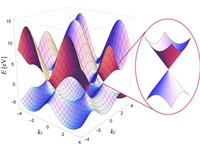
Band structure of graphene
Graphene’s superior properties
 1. Highest intrinsic mobility (100 times higher than in Si)
 2. Longest mean free path at room T (micron range)
4. Strongest material ‘ever measured’ (theoretical limit)
5. Most stretchable material (up to 20% elastically)
6. Completely impermeable (even He atoms cannot squeeze through)
7. Largest surface-to-weight ratio (~2700 m2 per gram)
Potential applications of graphene
1. Touch screens, microelectronics
2. Composite materials
3. Tablet computers
4. Solar cells
5. Thin flexible light panel
6. Electronic payment
Raman Spectroscopy
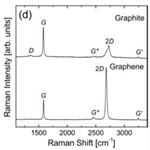 In our laboratory, we study the properties graphene with Raman spectroscopy. Raman spectroscopy is a useful tool in studying the vibrational energy of molecules and condensed matter (phonon). For several decades, it has played an important role in the research of graphitic materials such as CNT, graphite, and fullerene since one can study not only structural but also electronic properties with Raman spectroscopy. Raman spectra of graphite and graphene.
Number of graphene layers
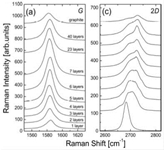
The thickness of single-layer graphene is only about 0.34 nm, which approaches the measurement limit of atomic force microscopy (AFM). The number of layers can be determined with the shape of Raman 2D band.
Interference effect of graphene on SiO2/Si
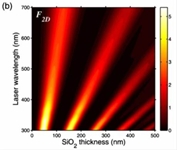
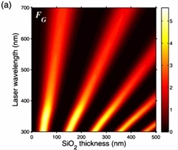
Thermal Conductivity of suspended graphene
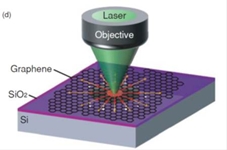
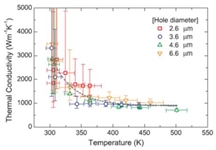
Graphene’s superior thermal properties are crucial in high-density large-scale integrated circuits where heat management is becoming more important as the density of devices grows. We used the Raman spectrum as a thermometer to obtain the thermal conductivity of suspended graphene.
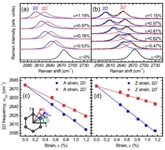
Strain-Dependent Splitting of Single layer graphene
Negative Thermal Expansion Coefficient
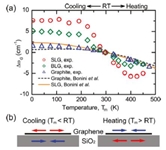
The thermal expansion coefficient of single-layer graphene is estimated with temperature-dependent Raman spectroscopy. Unlike most materials, graphene has a negative thermal expansion coefficient. The TEC mismatch between single layer graphene and the substrate causes strain on graphene, which can be measured by Raman spectroscopy.
References
[1] Graphene: carbon in two dimensions, M. I. Katsnelson, Materials Today 10, 20 (2007).
[2] Carbon wonderland, A. K. Geim and Phillip Kim, Scientific American 298, 68 (2008).
[3] Variations in the Raman Spectrum as a Function of the Number of Graphene Layers, D. Yoon et al., Journal of the Korean Physical Society 55, 1299 (2009).
[4] Interference effect on Raman spectrum of graphene on SiO2/Si, D. Yoon et al., Phys. Rev. B 80, 125422 (2009).
[5] Thermal conductivity of suspended pristine graphene measured by Raman spectroscopy, J. Lee et al., Physical Review B 83, 081419(R) (2011).
[6] Strain-Dependent Splitting of the Double-Resonance Raman Scattering Band in Graphene, D. Yoon et al., Physical Review Letters 106, 155502 (2011).
[7] Negative Thermal Expansion Coefficient of Graphene Measured by Raman Spectroscopy, D. Yoon et al., Nano Lett., 11 (2011), 3227.